CSJ Hiring Index signals highest hiring intentions since 2024


Canada’s hiring climate took a small but notable step forward in October. After a September marked by a sharp rebound in purchasing activity but lingering weakness across key sectors, the latest indicators suggest that momentum is slowly broadening. The CSJ Hiring Index rose to an estimated 5.8, up from 5.4 in September and well above August’s low of 4.8. October’s uptick, though modest, is the clearest sign in months that employers are gradually shifting from caution to early-cycle positioning.
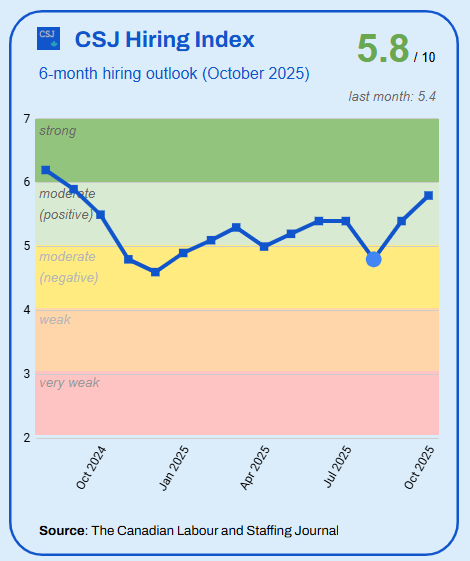
The most striking development comes from services. For the first time this year, the S&P Global Services PMI moved back into expansion territory at 50.5, ending a long stretch of contraction. It is a thin line above the threshold, but symbolically important: services account for the majority of Canadian employment, and even small improvements in activity tend to translate into stronger staffing pipelines.
Manufacturing followed a similar, if more restrained path. The sector remains in contraction, but the October reading of 49.6 marks its highest level in nine months. Taken together, these two shifts point to a broader stabilization in business conditions: still fragile, still uneven, but enough to nudge companies toward early hiring discussions and replenishment of critical operational roles.
By contrast, the Ivey PMI returned to a more subdued 52.4 after September’s surge. This cooling suggests firms are no longer front-loading purchasing decisions but returning to steadier, more sustainable activity. It also reflects a dynamic increasingly visible across Canada: hiring appetite is rising not because firms are accelerating, but because they have reached the limits of deferring talent decisions.
The labour market continues to show signs of slack, with unemployment holding higher than earlier in the year and wage growth running cooler than inflation. But these conditions, combined with improving PMIs, often precede a period of selective rehiring. Companies begin to rebuild capacity before demand fully recovers; the early hires tend to be in operations, logistics coordination, customer support, scheduling, and finance and accounting functions required to absorb incremental activity.
The next six months may therefore bring a subtle but meaningful shift. If services activity continues trending upward (hovering above or around the 50 line) and manufacturing holds its path toward stabilization, Canada could enter a period of measured labour market expansion by early 2026. It will not resemble a broad hiring wave; rather, it points to a pattern of targeted additions concentrated in functions tied to efficiency, throughput, and service continuity.
This pattern also aligns with a rising separation rate. As employees continue to move roles, retire, or exit sectors entirely, replacement hiring becomes a more important driver of staffing pipelines. Even in a lukewarm economy, firms cannot afford prolonged vacancies in critical operational jobs, and recruitment demand tends to rise accordingly.
If these trends persist, the labour market may transition from the defensive posture of mid-2025 to a more cautiously expansionary phase. The climb will be incremental rather than dramatic, but the direction of travel appears to have changed. In a landscape defined by uncertainty, October’s data has offered something in short supply this year: early signs of renewal.