Priced Like Software, Paid Like a Headhunter

AI-native recruiting startups are raising money at valuations that would make any staffing executive blink. The number worth studying is not the valuation. It is the fee.
In February 2025, a recruiting company most of the staffing industry had never heard of raised $100 million at a $2 billion valuation. Eight months later, in October, it raised another $350 million and the valuation had quintupled to $10 billion. By July 2026, according to reporting from TechCrunch and Forbes, it was in talks to raise roughly $500 million more at a valuation of $20 billion. The company is called Mercor. Its three founders were college students when they started it in January 2023, and none of them is yet twenty-five.
Those numbers belong to the vocabulary of software, not staffing. And that is precisely why they are worth a Canadian recruiter's attention. Mercor is not a technology vendor selling tools to agencies. It is a recruiting business, and it charges for placements the same way an agency does. The market is pricing it like a software company anyway.
Strip away the valuation and Mercor's model is familiar to anyone who has run a desk. It is, in its own description, a talent marketplace that connects skilled professionals with companies that need them, and it takes a recruiting fee of about 30 percent, with contractors keeping the majority of the top-line spend. A staffing firm would recognize that arithmetic immediately.
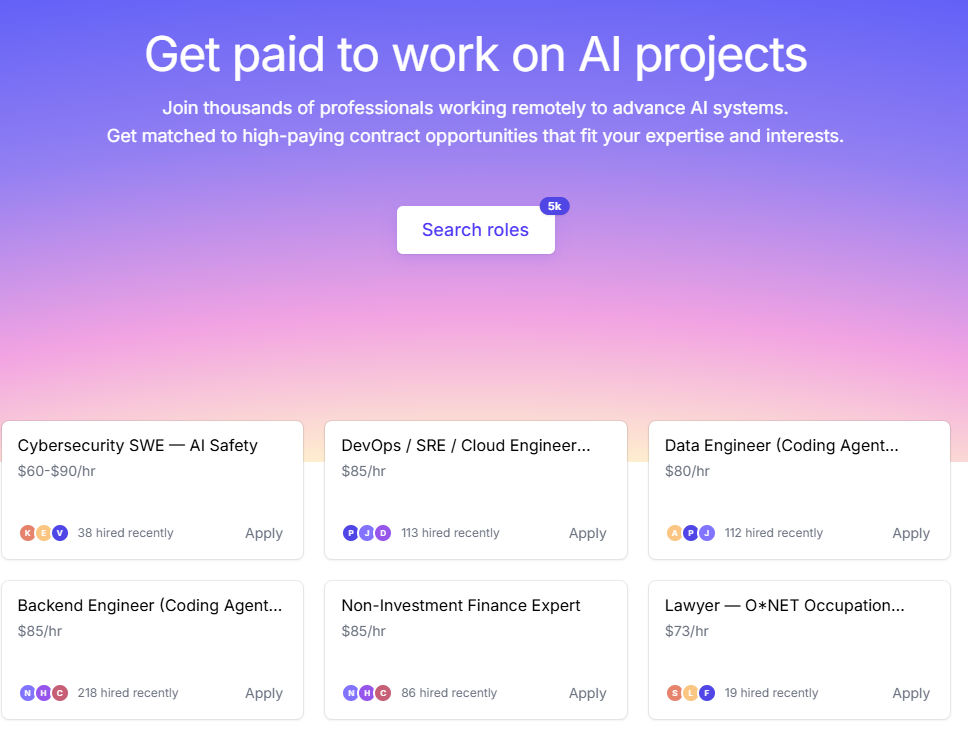
What is different is the machinery underneath. Mercor's niche is supplying human expertise to the AI labs, matching domain specialists to companies such as OpenAI, Anthropic, and Meta for the work of training and evaluating models. And it sources that talent through an AI system that conducts roughly twenty-minute video interviews, combining a discussion of experience with case-study assessment, at a scale no human recruiting team could match. The company reported annualized gross revenue of around $2 billion by mid-2026, up from $760 million at the end of 2025, per the research firm Sacra, and was reported to be profitable on a free-cash-flow basis early in the year. Even allowing that gross revenue flatters the picture, since most of it flows through to contractors, the growth curve is the kind investors have not seen in traditional staffing for a very long time.
Mercor is not alone, only the largest. In April 2026, a smaller AI-powered recruiting startup called Dex closed a $5.3 million seed round led by Notion Capital, one of a long line of similar raises tracked across the venture directories. The pattern is consistent: build the recruiting workflow AI-first, source and screen with models rather than headcount, and let the economics scale like a platform.
The obvious rebuttal writes itself. Mercor recruits PhD-level specialists for frontier AI labs. It does not staff a distribution centre in Mississauga or place bilingual customer-service agents in Montreal. The overlap with the day-to-day Canadian staffing market is, for now, close to zero.
That comfort is real but temporary, and it misreads what the capital is betting on. Investors are not valuing Mercor at $10 billion because they believe the market for AI-lab data annotators is worth $10 billion. They are valuing it because they believe the model generalizes: that an AI-native marketplace can source, screen, and match candidates at a fraction of the cost per placement that a human-led agency incurs, and that once the machinery works in one vertical it can be pointed at others. The 30 percent fee is the tell. It says these companies intend to be paid like recruiters while operating like software, and software margins do not stay confined to a niche when the capital behind them is this patient.
For a Canadian agency, the competitive question is therefore not "will Mercor take my clients this year." It is "what happens to my fee when a client can point an AI marketplace at a role and get a screened shortlist by morning at half the cost." The disclosure debate playing out in Ontario, where regulators now require employers to admit when a machine is reading the résumés, is in one sense the public catching up to a shift that venture capital has already priced.
None of this warrants panic, and the honest read is bounded on both sides. The AI marketplaces are formidable at the top of the funnel, where volume, speed, and pattern-matching are the whole game. They are far less proven at the parts of the business that have always justified the human recruiter's fee: understanding a client's culture well enough to place someone who lasts, managing the messy human moments of a counteroffer or a fallen-through start date, and carrying the compliance and co-employment obligations that come with placing workers in a regulated Canadian labour market. A twenty-minute AI video interview is a screening tool, not a relationship.
The specialized nature of Mercor's niche is also doing more work than the headline valuation admits. Matching a machine-learning researcher to a frontier lab is a problem with clean signal: credentials, a portfolio, a case study that either holds up or does not. Much of the Canadian staffing market lives in the opposite condition, placing workers whose fit turns on availability, reliability, and judgment that no résumé captures and no case study reveals. The AI marketplaces will find those verticals harder than the venture math assumes.
The lesson to draw is neither dismissal nor alarm. It is that the recruiting fee is now contested territory, and the contest is being funded at a scale the staffing industry has not faced before. The agencies that come out ahead will be the ones that get honest, quickly, about which parts of their fee are defensible and which parts are simply the price of doing a task a model will soon do cheaper.
Subscribe now for free and have access to all our stories, enjoy exclusive content and stay up to date with constant updates.
Already a member? Sign in