OpenAI disrupting staffing, Carney in the majority and a 14,000 job add


Good morning, everyone.
It’s been a whirlwind couple of weeks in the Canadian labor market, and I’m glad we can take a moment to look at the bigger picture together. Between the shifting political tides in Ottawa and the evolving data from the latest Labour Force Survey, it’s clear that the "wait-and-see" approach some of our clients have been taking is finally coming to an end. We’re moving into a more aggressive, predictable, yet highly selective environment.
Over the last two weeks, we’ve explored the significant structural shifts occurring in our industry. We first looked at the "Carney Majority" following the April 13 special elections. With the Liberal party hitting the 172-seat threshold, the legislative "brake" is off. This means faster rollouts for initiatives like the $5 billion Strategic Response Fund and a more forceful push for internal trade mobility; changes that will demand faster, more decisive action from staffing firms.
We also broke down the "K-shaped" hiring recovery. While the overall market might feel flat, specific "islands of growth" are thriving. From the 32,000-person surge for the 2026 Census to massive infrastructure investments by utility giants, the demand is there; it’s just more concentrated than it used to be. Finally, we touched on the potential disruption from OpenAI. As they move toward "conversational sourcing" and skills-first matching, our role must shift toward high-touch advisory and human judgment that algorithms can't yet replicate.
Minh Dang - Editor in Chief
The release of the March 2026 Labour Force Survey offers a much-needed narrative of stabilization for the Canadian economy. After a tumultuous start to the year characterized by a staggering loss of over 100,000 positions in January and February, the market added a modest 14,000 jobs in March. This pivot suggests that while the aggressive "low-hire, low-fire" dynamic remains the dominant theme of the current cycle, the sharp contractionary period may be tapering off. For staffing firms and recruitment professionals, these results underscore a transition from crisis management to a strategic, sector-specific focus as the industry navigates a 6.7% national unemployment rate.
The political landscape in Ottawa underwent a fundamental shift following the special elections on April 13, 2026. With the Liberal victories in University-Rosedale and Scarborough Southwest, Prime Minister Mark Carney has secured 172 seats, the precise threshold for a majority. For the staffing industry, this is not merely a change in seat count; it is the removal of the structural "brake" that has moderated labour policy since the 2025 election.
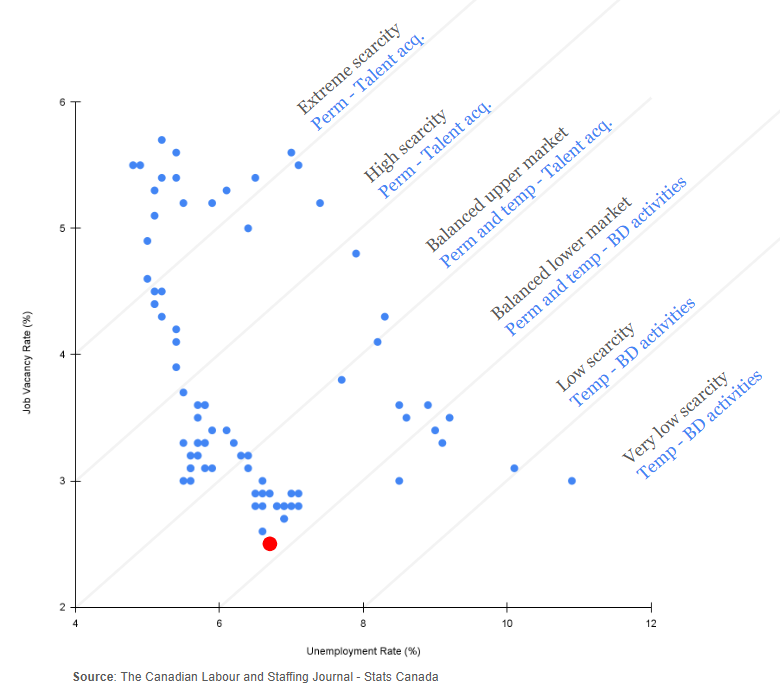
The Canadian labor market has reached a definitive turning point, marking the end of the post-pandemic "talent grab." To navigate this shift, staffing leaders must understand the mechanics of the Beveridge Curve; the inverse relationship between job vacancies and unemployment. The current positioning of the market, characterized by an unemployment rate of 6.7% and a job vacancy rate of 2.5%, places the industry firmly in a "Low Scarcity" environment. This is a stark contrast to the peak of 2022, when vacancies surged to 5.7%.
The Q2 2026 market is defined by specialized volume rather than general hiring. These ten organizations represent the most verified recruitment volume opportunities in the country this quarter:
The entry of OpenAI into the recruitment ecosystem marks a significant shift from digital transformation toward AI-native intermediation. This move reimagines the bridge between project inception and talent acquisition, moving away from static databases toward a sophisticated semantic matching engine. By embedding talent discovery directly within the ChatGPT interface through integrations like Upwork, the platform allows for "conversational sourcing." For traditional staffing firms, this represents a new level of competition for the initial screening of candidates.