The optimal strategy for staffing firms today: trust the statistics


The Canadian labor market has reached a definitive turning point, marking the end of the post-pandemic "talent grab" and the beginning of a more challenging, client-driven era. To navigate this shift, staffing leaders must look beyond simple headlines and understand the mechanics of the Beveridge Curve (the inverse relationship between job vacancies and unemployment) and how it dictates the optimal strategy for a recruitment firm.
The current positioning of the market, characterized by an unemployment rate of 6.7% and a job vacancy rate of 2.5%, places the industry firmly in a "Low Scarcity" environment. This is a stark contrast to the peak of 2022, when vacancies surged to 5.7% while unemployment bottomed out at 4.9%. During that period of "Extreme Scarcity," the primary constraint on growth was candidate supply. Staffing firms that prioritized talent acquisition and permanent placements were handsomely rewarded, as desperate employers were willing to pay premium fees for any available qualified talent.
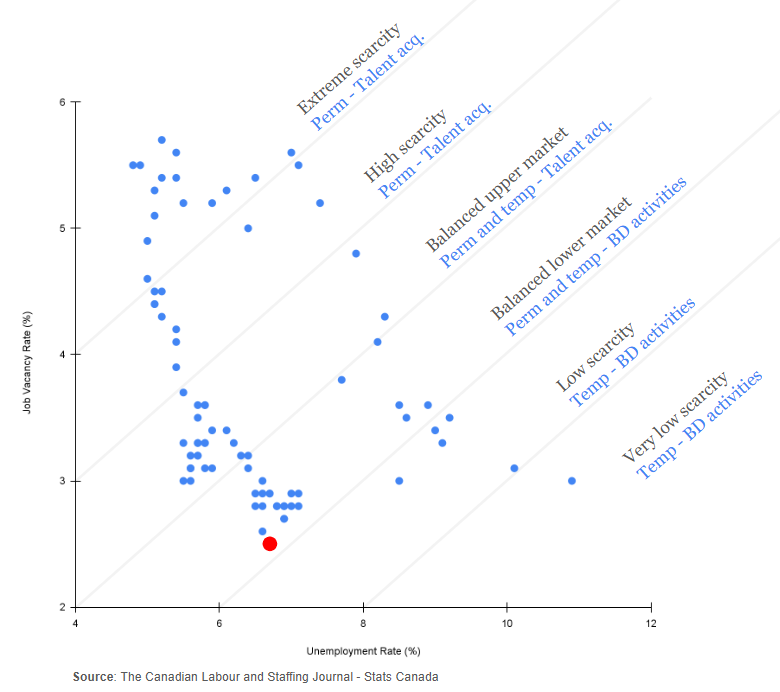
Today, the red dot on the market map has migrated toward the bottom-right. This movement signifies a "Balanced Lower Market" where the scarcity of talent has been replaced by a scarcity of opportunity. There are now significantly more active job seekers for every open requisition than at any point in the last four years. In this environment, the fundamental challenge for a staffing firm is no longer "Who can I find?" but rather "Who is actually hiring?"
For firm owners and leaders, this shift necessitates an immediate pivot in operational priorities. The era of passive order-taking is over. The current data suggests three primary strategic imperatives for the remainder of 2026:
Subscribe now for free and have access to all our stories, enjoy exclusive content and stay up to date with constant updates.