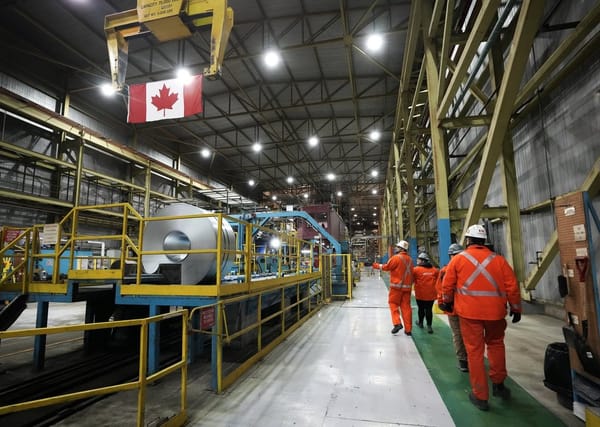


Canada’s labour market entered the fall with a quieter rhythm. According to the latest data from Statistics Canada, payroll employment barely moved in August rising by just 3,300 positions (+0.0%) while job vacancies dropped by 11,300 (-2.4%) to 457,400, the lowest level since 2017.
by Minh Dang
The Bank of Canada’s latest decision to lower its policy rate to 2.25 percent marks a delicate moment in Canada’s post-pandemic economic recovery. The move, which brings the rate to the lower bound of what the Bank considers a “neutral range,” reflects an economy that is neither
by Minh Dang
The industrial labour market is not collapsing. It’s reorganizing. The last month of job posting data across key blue-collar and technical roles shows a market that is shifting away from pure expansion and moving toward resilience. Some categories are cooling, some are stabilizing, and some are quietly surging. Demand
by News Room
Canada’s new federal budget marks a turning point in how the country approaches its workforce. Released on October 27, 2025, the plan leans heavily on one theme: rebuilding Canada through its people. Training, credential recognition, worker mobility, and income protection all take centre stage, signaling a deeper shift in
by Minh Dang
The spread of generative artificial intelligence has moved beyond hype and headlines; it is now showing up in payroll data. A new study from the Stanford Digital Economy Lab, Canaries in the Coal Mine? Six Facts about the Recent Employment Effects of Artificial Intelligence, traces the first measurable labour market
by Minh Dang
For decades, permanent placements were the lifeblood of the staffing industry: reliable, lucrative, and central to how firms measured success. Each hire placed into a long-term role meant stability for clients and strong margins for agencies. But that foundation is cracking. Across North America and Europe, the traditional direct hire
by News Room
When Donald Trump announced yet another wave of tariffs on Canadian goods, it served as a sharp wake-up call. For decades, Canada’s economic map has pointed south: roughly three-quarters of its exports head to the U.S., and large chunks of its manufacturing, energy and resource flows move across
by Minh Dang
In what may become a landmark moment for the staffing and finance industries, OpenAI has quietly embarked on a project to recruit more than 100 former investment-banking analysts and associates from firms such as JPMorgan Chase, Goldman Sachs and Morgan Stanley to train its AI systems in financial modelling. These
by News Room
Canada’s labour market entered the fall with a quieter rhythm. According to the latest data from Statistics Canada, payroll employment barely moved in August rising by just 3,300 positions (+0.0%) while job vacancies dropped by 11,300 (-2.4%) to 457,400, the lowest level since 2017.
by Minh Dang
Canada’s technology labour market has entered a new phase in 2025—one marked not by the exuberant hiring cycles of the late 2010s, nor by the correction of the early 2020s, but by a more structural tension between digital ambitions and the talent required to deliver them. Across the

The federal government’s latest procurement disclosures show that National Defence remains the single largest buyer of temporary help services in Canada, accounting for the overwhelming majority of active staffing contracts through the third quarter of 2025. According to open-data records, over a dozen HR and recruitment vendors held active

After months of subdued momentum, Canada’s hiring appetite is stirring again. The September CSJ Hiring Index rose to 5.4 out of 10, up sharply from 4.8 in August, signaling a tentative shift in employer sentiment as purchasing activity accelerates and some hiring pipelines reopen. Yet beneath the

Digital staffing is no longer a niche experiment. Across Canada, warehouse operators, healthcare institutions, and logistics firms are turning to apps that can fill shifts in minutes, while major agencies are racing to digitize their own operations. The competition now spans from domestic startups to global firms integrating AI-driven matching,

Want more specific insights on the Canadian labour market? We prepared a set of 4 reports that bring specific analysis on: * IT staffing * F&A staffing * Skilled Trades staffing * Manufacturing staffing This report is for premium subscribers only, to discover all insights and support our work, please consider a

The Canadian staffing industry has faced turbulence in the past 3 years. Will 2026 bé a reset? Download the most comprehensive and detailed analysis of the Canadian staffing industry in our latest Canadian Staffing Industry 2026-2027 Forecast & Deep Dive Report at this link! To receive the report, simply subscribe

The increased return to work mandates Recently, The Wall Street Journal reported that despite stronger return-to-office (RTO) mandates across major U.S. companies (Microsoft, NBCUniversal, Paramount, The New York Times, among others), average office attendance has barely budged. Employers are struggling to enforce mandates. High performers often face minimal consequences

Canada’s labour market entered the fall with a quieter rhythm. According to the latest data from Statistics Canada, payroll employment barely moved in August rising by just 3,300 positions (+0.0%) while job vacancies dropped by 11,300 (-2.4%) to 457,400, the lowest level since 2017.
by Minh Dang
The Bank of Canada’s latest decision to lower its policy rate to 2.25 percent marks a delicate moment in Canada’s post-pandemic economic recovery. The move, which brings the rate to the lower bound of what the Bank considers a “neutral range,” reflects an economy that is neither
by Minh Dang
The industrial labour market is not collapsing. It’s reorganizing. The last month of job posting data across key blue-collar and technical roles shows a market that is shifting away from pure expansion and moving toward resilience. Some categories are cooling, some are stabilizing, and some are quietly surging. Demand
by News Room
Canada’s new federal budget marks a turning point in how the country approaches its workforce. Released on October 27, 2025, the plan leans heavily on one theme: rebuilding Canada through its people. Training, credential recognition, worker mobility, and income protection all take centre stage, signaling a deeper shift in
by Minh Dang
The spread of generative artificial intelligence has moved beyond hype and headlines; it is now showing up in payroll data. A new study from the Stanford Digital Economy Lab, Canaries in the Coal Mine? Six Facts about the Recent Employment Effects of Artificial Intelligence, traces the first measurable labour market
by Minh Dang
For decades, permanent placements were the lifeblood of the staffing industry: reliable, lucrative, and central to how firms measured success. Each hire placed into a long-term role meant stability for clients and strong margins for agencies. But that foundation is cracking. Across North America and Europe, the traditional direct hire
by News Room
When Donald Trump announced yet another wave of tariffs on Canadian goods, it served as a sharp wake-up call. For decades, Canada’s economic map has pointed south: roughly three-quarters of its exports head to the U.S., and large chunks of its manufacturing, energy and resource flows move across
by Minh Dang
In what may become a landmark moment for the staffing and finance industries, OpenAI has quietly embarked on a project to recruit more than 100 former investment-banking analysts and associates from firms such as JPMorgan Chase, Goldman Sachs and Morgan Stanley to train its AI systems in financial modelling. These
by News Room