Welcome to the second edition of The Recruiter Corner, a space dedicated to translating macroeconomic shifts into actionable strategies for the talent acquisition ecosystem. Navigating the current Canadian employment landscape requires looking past headline percentages to understand the structural changes affecting workforce availability and candidate expectations. This edition covers the widening sentiment gap among job seekers, tactical adjustments needed for entry-level hiring, and the specific organizations expanding their headcounts this month.

1. The CSJ Labour Market Outlook: Labor Supply Surplus
The stabilization observed at the end of the first quarter has shifted into a more challenging phase for talent absorption. Canada lost 18,000 jobs in April, reversing the modest gains of the previous month and bringing the cumulative full-time employment decline for the year to 111,000 positions. Concurrently, a substantial influx of 51,000 active job seekers entered the workforce, pushing the national unemployment rate up two ticks to 6.9 percent, a six-month high.
This environment is characterized by weak hiring velocity rather than an acceleration of corporate layoffs, which actually remain ten percent below their late autumn peaks. The resulting labor market features an escalating supply surplus, granting employers significant leverage in selection criteria while presenting a highly competitive landscape for active candidates.
2. What sectors are hiring?
Data compiled from Indeed job postings tracks year-over-year percentage changes across diverse employment sectors, offering a real-time window into hiring demand. The headline index, represented by the prominent red baseline, indicates that overall hiring activity has shifted into negative territory after a brief stagnation.
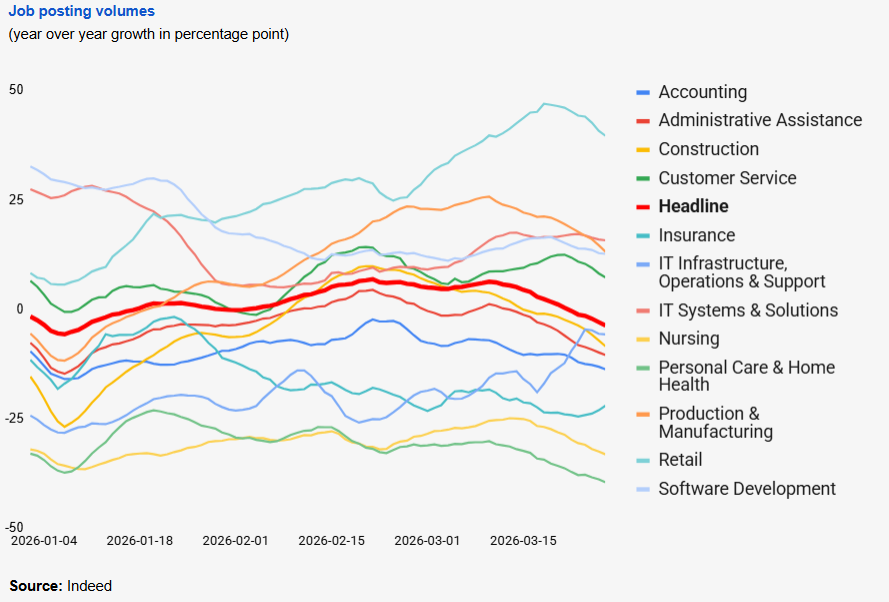
Over the last four weeks leading into late March 2026, the aggregate trend line dipped below the zero mark, confirming that total job openings are actively shrinking compared to the same period in the previous year. This deceleration aligns with broader macroeconomic headwinds, including sustained restrictive monetary policy by the Bank of Canada and a general softening in domestic consumer spending.
3. You have to work with a team you do not know at all. How would you integrate?
Having the right credentials for a job is one thing. But making sure the onboarding and integration is successful is another.
This week, our guest writer Adam Khizrane, Associate Managing Director at Horus Ressources Inc brings us his insightful point of view and advice on what are the best practices to avoid the usual pitfalls of workplace integration.

4. Candidate Climate: The Friction Points
The qualitative landscape is currently defined by structural friction points that require talent acquisition professionals to look beyond traditional recruitment metrics.
- Youth Employment Bottlenecks: The integration of young talent into the workforce faces severe economic headwinds. A weaker business climate and rising payroll overhead have forced small businesses to scale back training programs, driving youth unemployment up to 14.3 percent. With limited options, a growing segment of the population aged 15 to 24 is entering the market with significantly less foundational professional experience, requiring employers to adjust their onboarding frameworks and initial performance expectations.
- Sustained Unemployment Scarring: Persistent job search durations are altering the composition of the available talent pool. Over three percent of the core working-aged workforce has now been unengaged in employment for greater than six months. For recruiters, evaluating this segment demands a shift away from penalizing linear career gaps and toward assessing transferable skills, continuous learning initiatives, and adaptability.
- Technological Baseline Expectations: The utilization of automated tools has transitioned from an emerging trend to a baseline professional expectation, with nearly one-third of Canadian workers utilizing generative technology regularly. This behavior matches a tightening compensation expectation, where over eighty percent of young job seekers prioritize wage benchmarks over non-monetary perks. Job descriptions that omit clear technological components or transparent salary bands are seeing a measurable drop in engagement from highly qualified applicants.
5. Hiring Heatmap
The following companies have initiated targeted recruitment campaigns within the past two weeks, reflecting pockets of localized capital investment and headcount expansion across the country.
- Arc'teryx: The premium outdoor apparel brand is actively expanding its corporate operations footprint out of North Vancouver. Recruitment activity is centered on senior application engineering, product creation development leadership, global talent acquisition management, and specialized technical design roles to scale up its direct-to-consumer infrastructure and product lifecycles.
- OpenTable: Following the signing of a multi-year lease for a major new 24,000-square-foot office space in downtown Toronto, the restaurant technology company is actively scaling up its Canadian presence. The new hub is driving hiring across sales, finance, marketing, and customer service teams, while simultaneously recruiting for its global engineering team to focus on product development and backend infrastructure.
- Sunrise Farms: The major Canadian poultry processor has initiated a significant recruitment drive in southwestern Ontario backed by a 100.5-million-dollar investment for a new facility in Woodstock. Supported by Invest Ontario, the expansion is generating immediate headcount growth, creating roles for agricultural processing talent, quality control inspectors, and logistics management specialists to support the domestic supply chain.
- Sanofi Canada: The biopharmaceutical manufacturer has launched a major headcount expansion following a significant investment to scale its global Artificial Intelligence Centre of Excellence in downtown Toronto. The initiative is generating high-skilled job openings focused on artificial intelligence, machine learning, and advanced data analytics applied to pharmaceutical research and production logistics.
- Ubisoft Montreal & Behaviour Interactive: While portions of the digital media and entertainment sectors face shifting volumes, Montreal’s major gaming studios are maintaining targeted pipelines for highly specialized technical talent. Current openings remain focused on senior user interface programmers, technical animators, sound designers, and information technology risk management specialists.