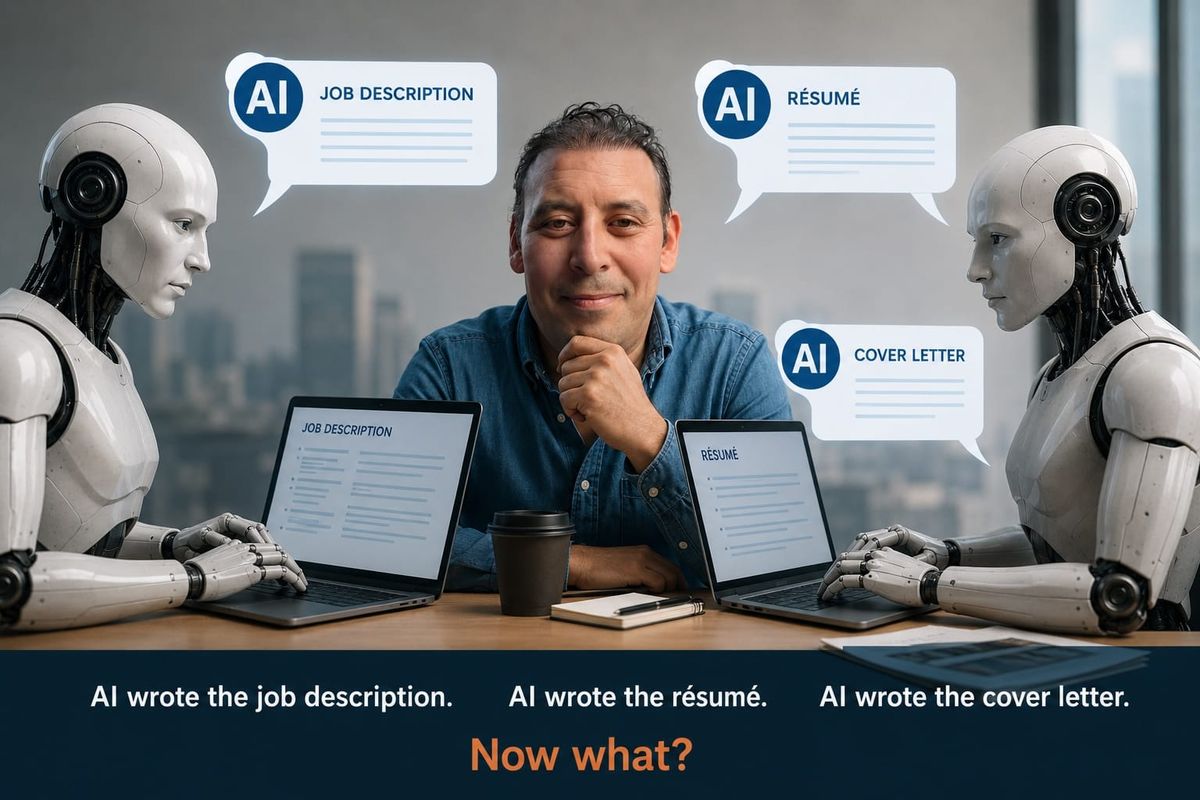
Let's be honest. There's something slightly absurd happening in hiring right now. A company uses AI to write a job description. A candidate uses AI to tailor their CV. AI helps generate the cover letter. Then a recruiter sits down and tries to determine whether there's a genuine match between two people.
Somewhere along the way, we have created a hiring process where algorithms are talking to algorithms, while humans are left trying to make sense of the conversation.
The real question is no longer whether AI is good or bad for recruitment. That ship has sailed. The question is: how do we assess talent when most of the information we are reviewing has already been filtered, optimized, and polished by AI? Here is what that means in practice, and what to do about it.
The CV isn't dead. But it's definitely losing value.
For years, recruiters have relied on the CV as one of the primary signals of candidate quality. Today, that signal is getting weaker. A candidate can upload a job description into ChatGPT/Claude and receive a customized résumé in minutes. They can optimize keywords, rewrite accomplishments, and craft a compelling narrative faster than ever before. Most aren't trying to deceive anyone. They are simply using the same tools everyone else is using.
But the result is that many applications now look remarkably similar. Better formatting. Better wording. Better alignment. Not necessarily better candidates. If your screening process still relies heavily on document matching, you are increasingly evaluating how effectively someone used AI, not how well they can actually perform the role. That is a very different thing.
The human advantage didn't disappear. It moved.
AI can help someone tell a story. It struggles to help them live one. When candidates talk about a project that went sideways, a difficult stakeholder they had to influence, or a decision they made under pressure, something changes. The conversation becomes less polished and more real. You hear hesitation. You hear ownership. You hear lessons learned. You hear things that don't fit neatly into a bullet point. No prompt can fully recreate that.
The same applies to recruiters. The instinct that tells you something doesn't quite add up, the follow-up question that wasn't in the interview guide, the curiosity that takes a conversation somewhere unexpected. Those skills suddenly matter more than ever.
If AI can prepare candidates perfectly, maybe we're testing the wrong things.
Many organizations are getting stuck here. They have added AI into the hiring process but haven't changed the process itself. Candidates now have access to better preparation tools than ever before, yet many companies continue to assess them using predictable interviews, generic scenarios, and standardized questions that can be rehearsed endlessly. If AI can help someone prepare for every step of your process, your process may no longer be revealing what you think it is.
A few adjustments can make a big difference: move to live conversations earlier, spend less time evaluating written submissions, use real business problems instead of hypothetical exercises, ask about decisions made rather than just outcomes achieved, and introduce ambiguity that requires genuine thinking in the moment. The goal isn't to catch people off guard. It's to create opportunities for authenticity.
This post is for free and paying subscribers only
Subscribe now for free and have access to all our stories, enjoy exclusive content and stay up to date with constant updates.